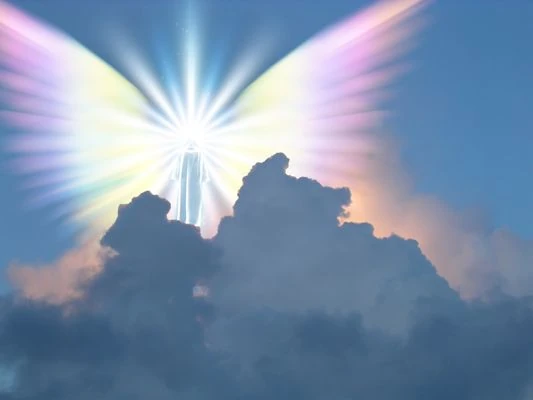

Angels (Mala'ika, ملائكة) in Islam are supernatural beings created by Allah from pure light (nur). They are one of the fundamental aspects of Islamic theology and serve as messengers, recorders, guardians, and executors of divine commands. Unlike humans and jinn, angels possess no free will; they exist in complete submission to Allah and cannot disobey Him. Their nature, behavior, and functions are described throughout the Qur'an and Hadiths, making them central to Islamic belief.
Origins and Nature
Creation
Islamic tradition states that angels were created before humans and jinn, from divine light:
“The angels were created from light, the jinn were created from a smokeless fire, and Adam was created from what has been described to you.” — Sahih Muslim, 2996
Unlike humans, who are made from clay, and jinn, who are made from smokeless fire, angels exist as purely spiritual beings without physical needs such as food, sleep, or reproduction. They have no gender and do not age or die like living creatures.
Anatomy and Appearance
Physical Form
Although angels are typically invisible to human eyes, Islamic scripture describes them as possessing wings and having varying sizes and numbers of wings depending on their rank and duty:
“[All] praise is [due] to Allah, Creator of the heavens and the earth, [who] made the angels messengers having wings, two or three or four. He increases in creation what He wills. Indeed, Allah is over all things competent.” — Surah Fatir (35:1)
Some angels, such as Jibril (Gabriel), have been described as enormous and possessing six hundred wings that cover the horizon. Others, like Israfil, are depicted as having a gigantic form that bridges heaven and earth.
Ability to Shape-Shift
While their true forms are often beyond human comprehension, angels can take physical forms that resemble humans. Jibril, for instance, often appeared in the form of a man when delivering revelations to the Prophet Muhammad (ﷺ):
“The angel Jibril used to come to the Prophet in the form of Dihyah al-Kalbi.” — Sunan Abi Dawood, 3976
When angels assume human form, they appear as pure and strikingly beautiful beings. However, some angels, such as the Angels of Death, may appear in fearsome and overwhelming forms when fulfilling their duties.
Behavior and Abilities
Lack of Free Will
Unlike humans and jinn, angels do not possess free will. They are incapable of sin and act only according to Allah’s commands:
“They do not disobey Allah in what He commands them but do what they are commanded.” — Surah At-Tahrim (66:6)
They are in a constant state of obedience, worshiping Allah day and night without tiring.
Supernatural Abilities
- Flight: Angels can traverse the heavens and the earth instantly.
- Immortality: They do not suffer from hunger, thirst, or death (until the Day of Judgment).
- Extreme Strength: Angels, such as those who carried Allah’s Throne or destroyed past nations, have immense power beyond human capability.
- Omnipresence (in Large Numbers): Millions of angels exist, occupying every part of creation, from the skies to the depths of the earth.
Roles and Functions
Messengers (Jibril, Gabriel)
Jibril (Gabriel) is the chief messenger angel responsible for delivering divine revelations. He is the angel who conveyed the Qur’an to the Prophet Muhammad (ﷺ) and communicated with previous prophets.
“Whoever is an enemy to Jibril—it is he who has brought the Qur’an down upon your heart, by permission of Allah.” — Surah Al-Baqarah (2:97)
Record Keepers (Kiraman Katibin)
Every human has two recording angels, one on the right and one on the left, who document every deed:
“When the two receivers receive, seated on the right and on the left. Not a word does he utter but that there is a watcher prepared [to record it].” — Surah Qaf (50:17-18)
Guardians (Hafaza)
Angels known as Hafaza (protectors) are assigned to individuals to guard them from harm:
“For each one are successive [angels] before and behind him who protect him by the decree of Allah.” — Surah Ar-Ra’d (13:11)
The Angel of Death (Malak al-Mawt) and His Assistants
The Angel of Death (Malak al-Mawt) is responsible for taking souls at the time of death:
“Say, ‘The Angel of Death will take you who has been entrusted with you. Then to your Lord you will be returned.’” — Surah As-Sajdah (32:11)
His assistants extract souls gently from the righteous and harshly from the wicked.
Punishers (Az-Zabaniya and Malik)
The Az-Zabaniya angels are the tormentors of Hell. Their leader, Malik, oversees Hell and never smiles:
“And they will call, ‘O Malik, let your Lord put an end to us!’ He will say, ‘Indeed, you will remain.’” — Surah Az-Zukhruf (43:77)
The Trumpet Blower (Israfil)
Israfil is responsible for blowing the trumpet to signal the end of the world and resurrection:
“And the Horn will be blown, and whoever is in the heavens and whoever is on the earth will fall dead except whom Allah wills. Then it will be blown again, and at once they will be standing, looking on.” — Surah Az-Zumar (39:68)
Mentions in Islamic Eschatology
Angels play a crucial role in the Day of Judgment:
- Munkar and Nakir question souls in the grave.
- Israfil blows the trumpet to initiate resurrection.
- Jibril, Mikail, and Malik oversee divine commands.
The Qur’an describes angels surrounding Allah’s Throne on Judgment Day:
“And you will see the angels surrounding the Throne, exalting Allah with praise.” — Surah Az-Zumar (39:75)
Final Thoughts
Angels in Islam are not mere symbols or metaphors but real, conscious beings created by Allah to carry out His divine commands. They have distinct ranks, roles, and abilities, influencing everything from revelation to death and the afterlife. Their obedience, power, and presence throughout creation serve as constant reminders of Allah’s authority and justice.
Their significance in Islamic belief is profound, shaping Muslims' understanding of the unseen world and reinforcing the reality of accountability, mercy, and divine order in the universe.